Before the Group Chat: How People Kept in Touch at a Distance
Before the group chat, letters, calling cards and relay messages connected people at a distance. Learn what each form could carry, and what it could not.
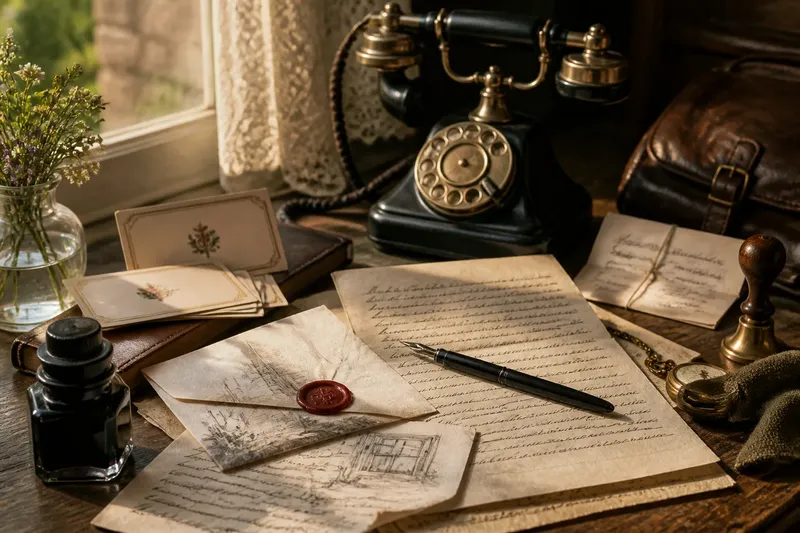
How did people keep in touch across distance before a quick message could arrive on demand? Letters, calling cards, messengers and arranged telephone calls each offered a different way to make contact, shaped by local customs and the means people could access. None was universal.
The historical point is less that correspondence was more sincere than it is now, and more that its forms imposed different limits. A letter took space and time; a card could mark a visit in some communities; a messenger depended on a willing carrier. Even the simplest method required someone to get the message where it was going.
Letters left room for a considered reply
A letter separated writing from receiving. The sender could describe a change at home, ask several questions or tell a longer story. The recipient could read it privately and reply when circumstances allowed. The pace was slow, but the message could hold more than a brief report.
Paper, ink and an envelope made a portable object. In some circumstances, a folded sheet served instead. Someone who could not or did not write might dictate a message to another person, but then privacy depended on that intermediary. Handwriting could make a letter recognisably personal, though it did not remove practical barriers such as literacy, materials or access to a postal route.
Letters suited exchanges that could tolerate a pause. They were less useful for urgent arrangements or where sending and receiving post was difficult. A missing reply might reflect a delayed delivery, a changed address or many other circumstances; silence offered no explanation on its own.
Say a person has moved from a village to a distant town and wants an older relative to know more than the new address. They write about the room, sketch its window and ask about the relative’s garden. The result is a fuller account that can be reread and answered later, though it still depends on the letter reaching its destination.
A letter could carry the story; it could not make the route shorter.
Calling cards belonged to particular social conventions
In some nineteenth-century British and European social settings, calling cards were used to announce or acknowledge visits. A card bearing a person’s name might be left at a household when the intended recipient was unavailable. The precise meaning depended on local etiquette, period and household practice; it should not be treated as a custom shared by everyone.
A card was not a small letter. It generally carried little room for news, but could make a visit or attempted contact visible to people who understood the convention. A recipient might respond according to the practices of that social circle. Without shared knowledge of the custom, the gesture could be unclear.
Use of calling cards was shaped by class, gender and household arrangements, among other circumstances. In some households, a servant or another intermediary might receive or carry a card. That does not make the practice a universal feature of domestic life, or a straightforward substitute for conversation.
Imagine someone newly arrived in a town where formal calls are part of the local social code. They visit a neighbour’s home, find no one available and leave a card bearing their name. The household can learn that a call was made; whether that leads to a reply depends on the people and conventions involved.
A card’s meaning travelled only as far as the custom was understood.
Messengers and telephone calls depended on access
A short note could travel with a relative, neighbour, servant, traveller or hired messenger. This might suit local news that could not wait for the next expected post. It also meant relying on a carrier, and the sender had to consider whether the message was suitable for another person to see or hear.
Telephone calls offered a different option where service was available. Early access varied by place and household; equipment, service arrangements, privacy and suitable times all mattered. An arranged call could allow an immediate exchange, but it required both people to be able to speak at the same time. A letter did not, though it took longer and could carry more detail.
Imagine two relatives in neighbouring districts need to change a meeting place before the usual post arrives. One has a trusted neighbour already travelling between them, so the sender gives that person a short sealed note. The recipient learns the new location in time to adjust, but the message has passed through another person’s hands. If a suitable telephone connection and private time are available instead, an arranged call avoids that particular intermediary.
The choice depended on the route, the message and what the people involved could use.
Which form suited the message?
When was a letter more useful than a calling card?
A letter could explain news, ask questions or invite a considered reply. A calling card, in settings where its conventions were recognised, could register a visit without carrying a longer account.
Could someone send a message through another person?
Yes, if a suitable carrier was available and the message was appropriate for that route. The sender had to allow for the possibility that the intermediary might see or hear it.
Why not use the telephone?
Telephone service was not equally available, and a call required both people to be able to speak at the same time. A letter could carry more detail without requiring simultaneous availability, but its arrival took longer.
Did everyone follow the same customs?
No. Access to writing, postal routes and telephones varied, as did local etiquette and household practice. A custom familiar in one community could be impractical or meaningless in another.
Different forms carried different limits
Letters, calling cards, messengers and arranged calls were not interchangeable. A letter could hold a fuller account; a card could register a visit within a recognised convention; a messenger or telephone call could carry a prompt update where the means were available. These distinctions help explain how people kept in touch at a distance without implying that any one method suited every place or household.
For the history of keeping in touch, the useful question is not which form was best in the abstract, but what it asked of the people using it: time to write, a shared social code, a trusted carrier or access to a telephone. The answer varied with ordinary circumstances, which were rarely as tidy as an etiquette book might suggest.